
“SHOW ME THE MONEY!”- Interest rates are rising
What the Fed—and interest rates—actually mean for your money
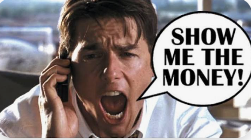
Jerry Maguire gave us one of the great movie catchphrases of all times, “Show me the money!”
And nearly 30 years later, it also happens to be a pretty good way to think about the Federal Reserve. Because when the Fed raises interest rates, we hear a lot about basis points, inflation expectations, dot plots and monetary policy.
Blah, blah, blah.
Here's the question most of us actually care about, what does a change in interest rates mean for my money? My savings. My mortgage. My bonds. My stocks. My retirement portfolio.
Because the Fed isn't just changing an obscure number in Washington, it's changing the price of money.
And when the price of money changes, it eventually finds its way into almost every corner of your financial life.
First, what exactly is the Fed doing?
The Federal Reserve sets a target for a very short-term interest rate called the federal funds rate. Think of the federal funds rate as the starting price for money. Change that price, and the effects ripple outward.
Banks change what they pay depositors. Borrowing costs adjust. Bond yields move. Companies reconsider investments. Investors rethink what they're willing to pay for stocks. Not everything moves immediately—or by the same amount—but the direction of travel matters.
So let's follow the money.
SHOW ME THE MONEY… in my savings account.
Here's the part of higher rates people tend to forget, if you're a saver, higher interest rates can actually be good news.
For years, we got used to earning almost nothing on cash after the global financial crisis and when interest rates where near zero. Higher short-term rates changed that. Savings accounts, money-market funds and short-term Treasury securities can offer meaningful income again.
But there is an important catch. Your bank doesn't have to pass the higher rate along to you. If you have a meaningful amount of cash sitting in a traditional savings account, take a look at what it's actually earning. That boring little number called APY suddenly matters and it should be trending up.
SHOW ME THE MONEY… in my mortgage.
This is where higher rates aren't nearly as much fun.
The Fed does not directly set mortgage rates. Longer-term mortgage rates are influenced by Treasury yields, inflation expectations, economic growth, credit conditions and what markets think the Fed will do next. But higher interest-rate environments generally mean borrowing becomes more expensive.
And that matters—a lot.
A higher mortgage rate doesn't just mean paying a little more interest. It can materially change how much house you can afford for the same monthly payment. The same idea applies to home-equity lines, auto loans and especially credit cards, many of which have rates that move more directly with short-term benchmarks.
So if you're carrying variable-rate debt or if you are about to take out a mortgage or a new loan, this is one place where a Fed decision can eventually become very personal.
SHOW ME THE MONEY… in my bonds investments.
This is where people often get confused. When interest rates rise, existing bond prices generally fall. Why? Well, its math. And if you want to know, read the next paragraph. But if math makes your eyes glaze over and roll into to the back of your head, skip to the following paragraph.
Bond prices are really just math. The price of a bond is the value today of all the cash it will pay you in the future. When interest rates rise, we discount those future cash flows at a higher rate, making them worth less today—and that’s why bond prices fall. That's the bad news.
Here's the good news, new bonds will be paying you more.
For investors who spent years wondering why they owned bonds that barely generated income, higher yields can make the fixed-income portion of a portfolio much more interesting. And remember why we own bonds in the first place. They're not necessarily there to be the star of the show. They're there for income, diversification, stability and—in many portfolios—to help balance the risk we're taking elsewhere.
Higher yields can give them more ability to do that job.
SHOW ME THE MONEY… in my stocks.
This one is less obvious. Higher interest rates create competition for stocks.
Imagine you can earn an attractive return on a relatively low-risk Treasury security. Suddenly, investing in a volatile stock has a higher hurdle to clear. Investors essentially say, if I'm going to take more risk, show me the money. That can put pressure on stock valuations, particularly for companies whose expected profits sit far into the future.
Higher borrowing costs can also affect companies directly. Debt becomes more expensive. Financing an acquisition costs more. Building a new factory costs more. Some projects that made sense when money was cheap no longer make sense when money is expensive.
But—and this is important—
Higher rates do not automatically mean stocks go down.
Markets are forward-looking. They care about why rates are changing, what inflation is doing, how fast the economy is growing, what corporate earnings look like and what investors already expected. Which is why trying to trade your portfolio around one Fed meeting is usually a very different exercise from investing for your retirement.
So…what am I supposed to do?
Probably less than the financial news would have you believe. A Fed meeting is a useful reason to review your financial life. It isn't necessarily a reason to rebuild it.
· Check what your cash is earning.
· Look at any variable-rate debt.
· Understand the role bonds are playing in your portfolio.
· And make sure your mix of stocks, bonds and cash still matches your goals, your risk tolerance and—something we've talked about a lot on The Edit—your time horizon.
THE EDIT
Jerry Maguire wanted someone to show him the money. I want you to know where your money is going—and what job it's supposed to be doing.
Interest rates matter.
They affect what you earn on cash, what you pay to borrow, what your bonds yield and how markets value stocks. But a quarter-point move from the Federal Reserve shouldn't suddenly turn a long-term investor into a short-term trader.
The Fed can change the price of money.
That doesn't mean it should change your plan.
And that may be the most important money line of all.
